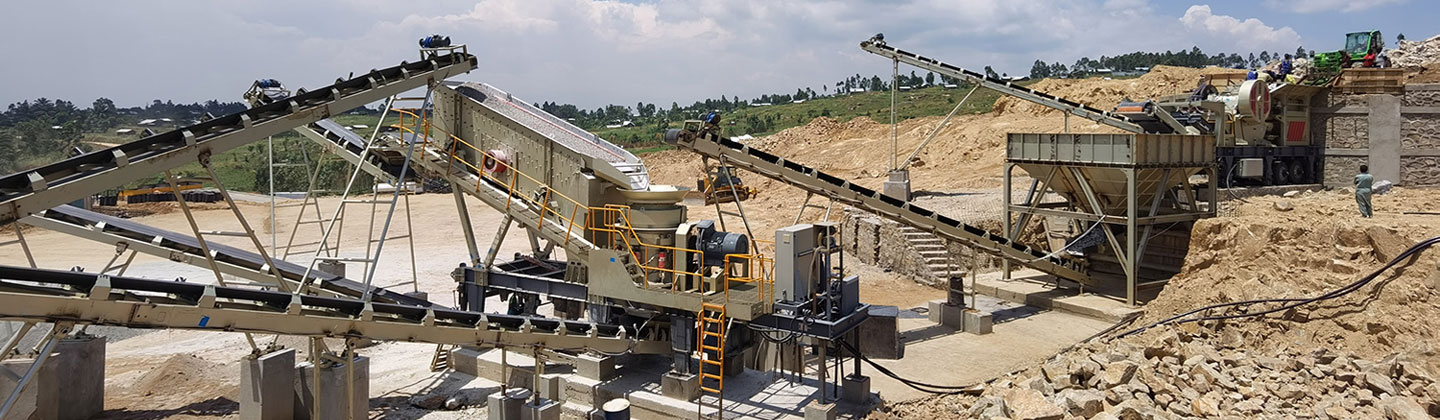
150 Tons/Hour Stone Crushing Plant for Sale: Capital Allocation and TCO Optimization Guide
For aggregate producers and mining investors, acquiring a 150 tons/hour stone crushing plant for sale is not merely a purchase of heavy machinery; it is a critical capital allocation decision. At 150 t/h, a production line sits at the turning point between micro-quarry operations and industrial-scale aggregate supply. Misjudging this threshold by over-specifying equipment drains capital through unutilized idle capacity, while under-specifying leads to premature component fatigue and inflated operating expenditures (OPEX).
Strategic Capacity Matching: Eliminating Idle Capital Strain
In industrial process engineering, systemic capacity imbalance is a frequent driver of poor asset turnover. When assembling a 150 t/h plant, each equipment module must be calibrated to ensure the 150 t/h metric represents a steady-state operational floor, rather than an unachievable theoretical peak.
Selecting oversized equipment creates a capital burden, trapping liquidity in unutilized steel and excessive motor ratings. Conversely, running a line at its absolute upper mechanical limit causes frequent unscheduled downtime. To achieve equilibrium around the 150 t/h target, equipment selections must be tightly aligned with proven performance envelopes:
| Equipment Model | Equipment Category | Rated Capacity Range | Power Rating | Max Feed Size | Strategic Operational Fit for 150 t/h Line |
|---|---|---|---|---|---|
| PEW860 | European Jaw Crusher (Primary) | 150–410 t/h | 110 kW | 720 mm | Operates efficiently at its lower boundary, ensuring reliable primary reduction without surging the circuit. |
| HPT300 | Multi-Cylinder Cone Crusher (Secondary) | 110–440 t/h | 220 kW | Variable / Coarse | Provides wide flexibility to scale throughput depending on chamber configuration and Closed Side Setting (CSS). |
| NK75J | Primary Mobile Crushing Station | 150–350 t/h | 141.4 kW | 680 mm | Integrates a PE3040 Jaw Crusher and FK0936 feeder, eliminating stationary civil infrastructure costs. |
By specifying assets like the PEW860 or the mobile NK75J, the primary stage remains unstrained by 150 t/h demands. This structural buffer protects downstream components from surge-loading, balancing the material flow across screens and conveyors without incurring the costs of true high-capacity infrastructure.
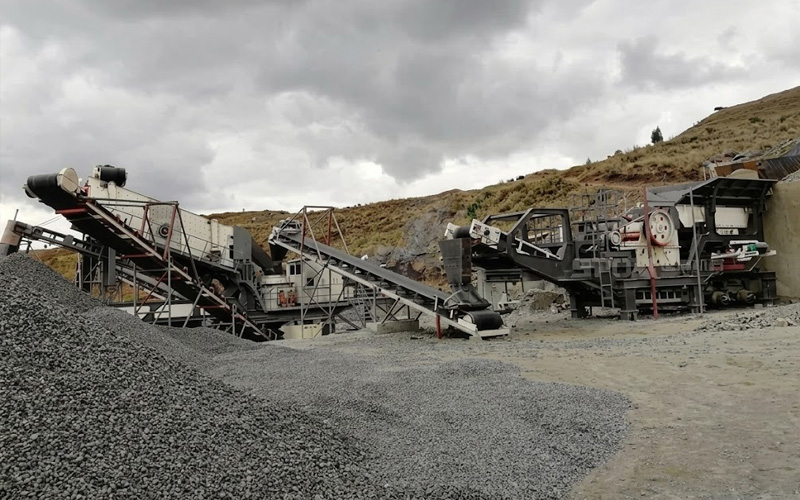
Two-Stage vs. Three-Stage Circuits: Economic Trade-Offs
The core configuration of your stone crushing plant dictates both your initial Capital Expenditure (CAPEX) and long-term product pricing potential. Investors must choose between a lower-cost, high-wear 2-stage configuration and an advanced circuit featuring specialized shaping capabilities.
The 2-Stage Configuration: Minimal CAPEX, Specific Material Constraints
A standard 2-stage plant typically utilizes a Primary Jaw Crusher paired with either a Secondary Impact Crusher (for soft to medium-hard stones like limestone) or a Secondary Cone Crusher (for abrasive materials like granite).
- CAPEX Advantage: Lower initial investment, fewer structural footprints, reduced conveyor count, and simplified electrical infrastructure.
- OPEX Risk: If processing high-silica rock through an impactor, wear-part depreciation rates escalate rapidly, compromising project margins. Additionally, 2-stage reduction often yields a higher percentage of elongated, flaky particles (needle-like material) that fail strict international concrete aggregate specifications.
The Advanced Shaping Circuit: Premium Product Strategy
An advanced configuration adds a tertiary vertical shaft impact (VSI) crusher, such as a VSI6X series sand maker, into a closed-loop circuit with high-frequency vibrating screens. Material enters a primary jaw, passes to a secondary cone, and undergoes final cubical reshaping and fine sand manufacturing.
- The Shaping Premium: While a tertiary circuit adds roughly 30% to 45% to initial CAPEX, it transforms the output. Flaky and elongated particles are reduced to under 8%, meeting premium concrete standards.
- Market Valuation ROI: Cubical aggregate and high-grade manufactured sand regularly command premium pricing in urban ready-mix concrete markets. By transforming waste fines into valuable manufactured sand, this circuit maximizes the revenue yield per ton of blasted rock.
Financial Architecture: TCO, Energy Efficiency, and Wear Optimization
A rigorous evaluation of a 150 tons/hour stone crushing plant for sale must look beyond the initial purchase price to analyze the total cost of ownership (TCO) across a standard 5-to-10-year asset lifecycle.
Energy Consumption Efficiency
Power delivery is one of the largest ongoing cash outflows in quarry operations. A standard 150 t/h fixed circuit utilizes approximately 350 kW to 450 kW of connected power across crushers, screens, and material transport.
Financial Impact: At an estimated industrial electricity rate, optimizing motor efficiency can significantly affect profitability. Utilizing modern hydraulic-adjusted systems, such as the HPT300 cone crusher (220 kW), improves power-to-ton ratios by delivering higher crushing forces per kilowatt compared to older, mechanical-spring alternatives.
Liner Wear Optimization and Maintenance OPEX
Unscheduled maintenance is a common challenge for operating margins. For a 150 t/h line processing hard stone, manganese liner wear in jaw and cone crushers represents a predictable, recurring cost. Advanced crushing chambers mitigate this by using inter-particle crushing dynamics, where rock crushes rock rather than rubbing directly against steel surfaces. This profile optimization extends liner longevity by 20% to 35%, directly lowering the maintenance OPEX budget.
The Infrastructure Trade-Off: Fixed vs. Semi-Mobile
Investors must weigh the financial implications of stationary versus mobile infrastructure:
- Fixed Plants: Require substantial upfront civil engineering costs, including reinforced concrete foundations, retaining walls, and localized environmental permitting. These costs are non-recoverable if the quarry site is depleted or the lease terminates.
- Semi-Mobile/Tracked Units (e.g., NK75J): Feature a higher initial equipment cost but reduce onsite civil preparation requirements. These mobile systems retain high residual asset value, can be easily liquidated or transferred to new projects, and simplify environmental compliance by tracking directly to the working quarry face.
Procurement and Payback Period Analysis
To establish a realistic payback period for a 150 t/h stone crushing plant, we examine a typical financial model based on a 2-stage configuration operating under steady-state conditions:
- Assumed Operational Metrics
- A standard operational framework assumes 150 tons per hour, running 8 hours per shift, 250 days per year, yielding an annual volume of 300,000 tons of sellable aggregate.
- CAPEX Allocation
- Includes primary crushing machinery (e.g., PEW860 or NK75J), secondary processing (e.g., HPT300), screening, heavy-duty conveyors, electrical control setups, and foundational site preparation.
- OPEX Breakdown
- Aggregated operating expenses comprise electricity/diesel usage, wear-parts replacement, localized site labor, maintenance allocations, and raw material extraction costs.
- Gross Revenue Projection
- Calculated against a conservative regional market value per ton for blended, graded aggregate (coarse fractions and sand).
- Estimated Amortization Window
- With balanced plant utilization, a well-matched 150 t/h circuit typically achieves full capital payback within 14 to 22 months of continuous operation. This timeline can be further optimized by introducing advanced shaping circuits that allow access to high-tier concrete markets.
When evaluating a 150 tons/hour stone crushing plant for sale, focusing on high-efficiency equipment configurations and matched component capacities helps protect working capital and build a resilient production model.