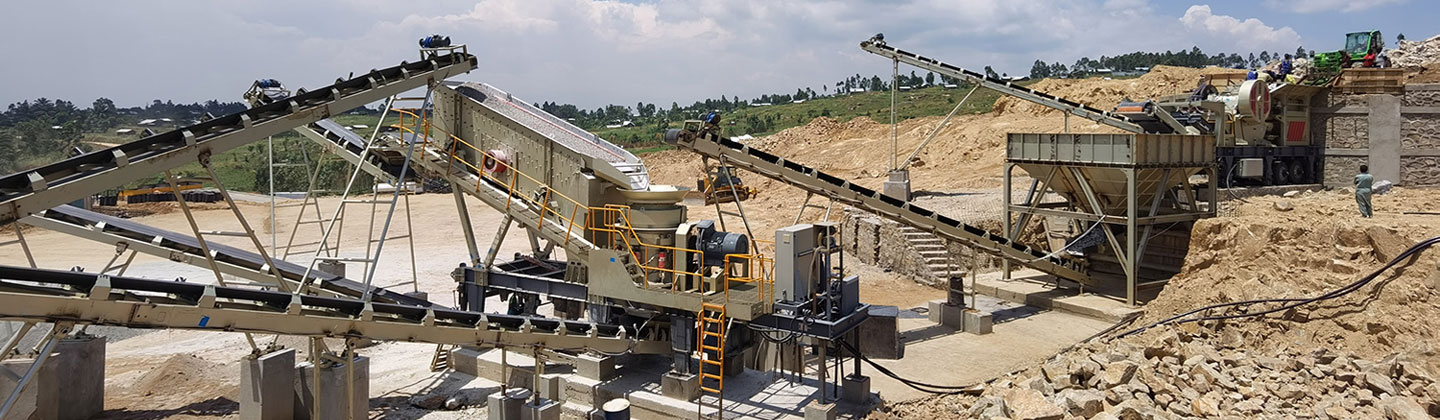
In the domain of civil engineering, the transition from raw granite to high-quality Manufactured Sand (M-Sand) is governed by the principles of Fracture Mechanics and Material Abrasiveness. Granite, characterized by a Mohs hardness of 6–7 and high silica (SiO₂) content, presents a significant challenge for conventional crushing equipment. To meet international standards for high-strength concrete, the production process must prioritize particle shape, grading, and the elimination of internal micro-cracks.
I. Material Characteristics: Hardness and Abrasivity Challenges
Granite’s polycrystalline structure, primarily composed of quartz, feldspar, and mica, dictates its behavior under stress. The high silica content results in extreme abrasiveness, which correlates directly with the wear rate of manganese steel and chromium alloys. From a material scientist’s perspective, selecting a standard building sand production granite crusher requires a system that manages energy consumption while mitigating the accelerated wear of sacrificial components.
II. Secondary Processing: The Role of HPT Multi-cylinder Hydraulic Cone Crushers
Effective sand production begins with proper feed preparation. The HPT Multi-cylinder Hydraulic Cone Crusher is strategically utilized in the secondary stage. By leveraging inter-particle crushing (laminated crushing), the HPT series does more than reduce size; it improves the internal stress distribution of the rock. This stage is critical for producing a cubical feed size (typically 13–40mm) optimized for the VSI stage, ensuring the final product maintains a stable Fineness Modulus.
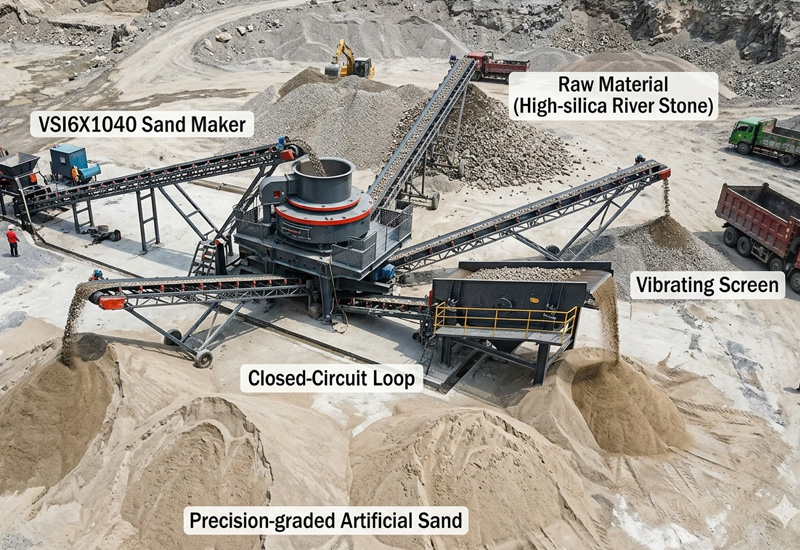
III. Tertiary Shaping: VSI6X “Rock-on-Rock” Principle
The VSI6X Series Vertical Shaft Impact Crusher represents the pinnacle of M-Sand technology. Unlike traditional impactors, the VSI6X utilizes the “Rock-on-Rock” (石打石) crushing principle. In this process, the high-speed impeller accelerates the material to a peripheral speed of 70–90 m/s, causing particles to collide within a pressurized material lining.
- Sphericity and Particle Shape: The high-velocity autogenous attrition rounds off sharp edges, resulting in a grain shape that significantly enhances the workability of concrete.
- Micro-crack Mitigation: By utilizing impact rather than compression in the final stage, the VSI6X reduces the propagation of internal micro-cracks, which are detrimental to the compressive strength of structural concrete.
- Wear Optimization: The “Rock-on-Rock” configuration ensures that the material itself acts as the wear liner, dramatically increasing the longevity of the machine’s internal structure when processing abrasive granite.
IV. Technical Parameters and Efficiency Data
For large-scale granite processing, the VSI6X1150 model provides the necessary throughput and velocity control. Based on laboratory and field data, the following specifications are standardized for high-abrasive material processing:
| Model | Max Feed (mm) | Throughput – Central & Waterfall (t/h) | Power (kW) | Impeller Speed (RPM) |
|---|---|---|---|---|
| VSI6X1150 | ≤ 45-50 | 344–544 | 2 × 200 / 2 × 250 | 1100–1510 |
| HPT300 | ≤ 230 | 115–440 | 220–250 | N/A (Secondary Stage) |
V. Conclusion: Achieving Standardized Aggregate Grading
The conversion of Granite to Manufactured Sand (M-Sand) is not merely a reduction in volume but a precision engineering task. By combining the compressive strength of the HPT Multi-cylinder Hydraulic Cone Crusher with the kinetic shaping of the VSI6X, producers can achieve a consistent Fineness Modulus (2.6–3.0) and a grading curve that adheres to ASTM or EN standards. This synergy ensures that the resulting building sand is suitable for the most demanding high-strength concrete applications, balancing high-abrasive material processing with economic operational costs.
- What is the Mohs hardness threshold for granite sand production?
- Granite typically falls between 6 and 7 on the Mohs scale. Materials in this range require laminated crushing or “Rock-on-Rock” impact technology to prevent excessive wear on machinery.
- How does the VSI6X improve the Fineness Modulus?
- By adjusting the impeller speed and the ratio between central feeding and waterfall feeding, the VSI6X precisely controls the percentage of fines (particles < 0.075mm), allowing for real-time optimization of the Fineness Modulus.
- Why use HPT before VSI for granite?
- The HPT Cone Crusher is designed for high-hardness materials. It provides a more uniform feed for the VSI6X, which maximizes the shaping efficiency and reduces the circulating load in the sand-making circuit.