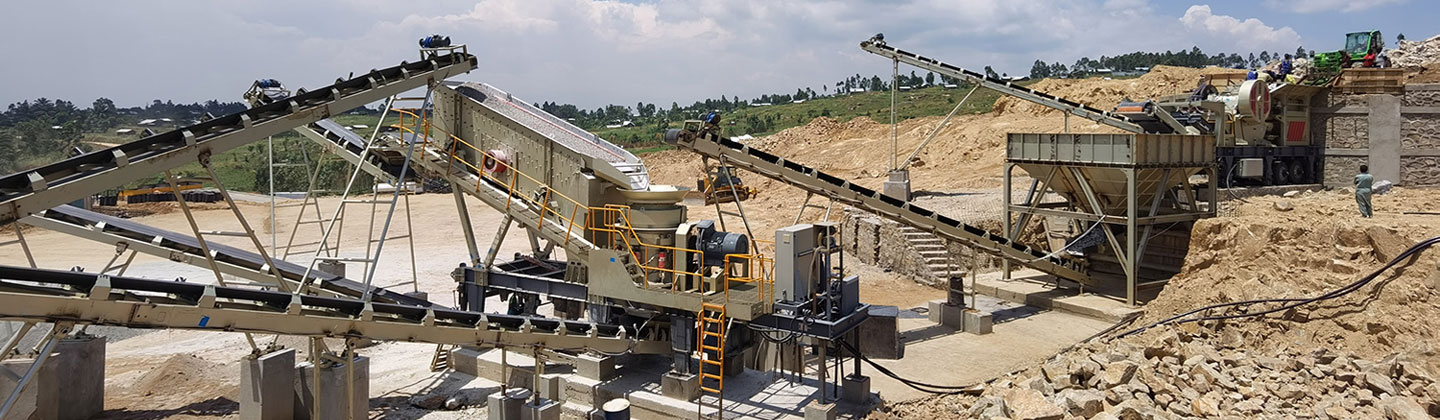
Limestone is widely processed into concrete aggregate, manufactured sand, cement feedstock, and other mineral products. Although it is generally considered a soft-to-medium hardness rock, its crushing behavior is governed by more than hardness alone. Fracture mechanics, cleavability, bedding planes, moisture, and internal defects all influence how limestone breaks during primary and secondary reduction. Selecting the right crushing equipment therefore requires balancing reduction efficiency, particle shape, fine-aggregate yield, wear, and dust generation. Jaw crushers, such as the C6X Series, and impact crushers, such as the CI5X Series, offer complementary approaches to this challenge.
Understanding Limestone Fracture Mechanics
Most limestone has a Mohs hardness of approximately 2.5–4, although values vary with mineral composition, silica content, recrystallization, and impurities. Compared with harder rocks such as granite or basalt, limestone generally requires less energy to initiate fracture. However, this relatively low hardness does not mean that crushing is automatically easy. Limestone can contain bedding planes, joints, fossils, cavities, and zones of different cementation, creating highly variable fracture paths.
During crushing, stress concentrates around natural defects. Once the applied stress exceeds the material’s local fracture strength, cracks propagate through weaker planes. Cleavability is particularly important because limestone often breaks preferentially along bedding or other planes of weakness. A crusher that exploits these natural fracture paths can achieve the required reduction with lower energy consumption and less unnecessary mechanical damage.
The objective is not simply to generate more fines. Excessive impact or compression can create micro-fractures inside otherwise desirable aggregate particles. These damaged particles may subsequently break during handling, screening, or concrete mixing, reducing product durability and increasing unwanted powder.
Primary Reduction: The Role of Jaw Crushers
Jaw crushers are primarily compression machines. In a C6X Series jaw crusher, limestone is compressed between a fixed jaw and a movable jaw until the applied stress exceeds its compressive strength. This mechanism is well suited to primary reduction because large feed particles can be reduced reliably without requiring extremely high impact energy.
For soft-to-medium limestone, controlled compression has an important advantage: it can exploit existing cracks and cleavable planes while limiting unnecessary shattering. Correctly selected discharge settings also help prevent excessive generation of ultrafines. This makes jaw crushing an effective first stage when the goal is to establish a consistent feed size for subsequent processing.
Wear management is another consideration. Because limestone is relatively soft, jaw plates can achieve favorable service life when the material contains limited abrasive silica. However, abrasive impurities can substantially change wear behavior. Proper chamber selection, feed distribution, and closed-side setting are therefore essential to prevent localized liner wear and maintain stable particle reduction.
Secondary Reduction: Impact Crushing and Fine Aggregate Production
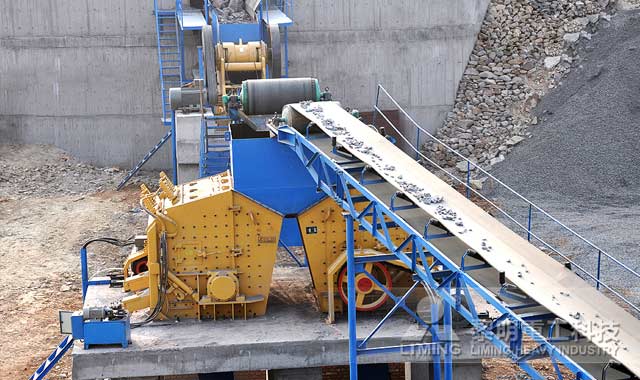
Impact crushers approach limestone fracture differently. The CI5X Series uses high-speed rotor impact to transfer kinetic energy to the feed. Rather than relying primarily on compression, the crusher creates tensile and shear stresses that cause limestone particles to fracture along internal weaknesses.
This mechanism is particularly useful in secondary crushing when a higher proportion of cubical particles and fine aggregate is required. Because limestone is comparatively brittle, appropriately controlled impact energy can break particles efficiently and produce favorable particle shapes. The key is to provide enough energy for complete fragmentation without excessive acceleration of wear or production of unnecessary dust.
Rotor speed, feed size, feed rate, impact-zone configuration, and discharge settings all influence the fracture pattern. Excessive impact energy can generate large quantities of fine powder and expose fresh mineral surfaces, increasing dust. It can also accelerate blow-bar abrasion, particularly when limestone contains quartz, chert, or other hard inclusions. Operating conditions should therefore be matched to the actual abrasiveness and fracture characteristics of the quarry material rather than relying solely on its nominal Mohs hardness.
Balancing Fines, Micro-Fractures, and Wear
A practical crushing circuit often benefits from combining the two mechanisms. A C6X Series jaw crusher can perform controlled primary compression, reducing run-of-mine limestone to a manageable size while preserving a relatively stable feed for the secondary stage. A CI5X Series impact crusher can then provide the additional size reduction and shaping needed for fine aggregate production.
This staged approach helps distribute mechanical stress rather than forcing a single crusher to perform the entire reduction ratio. It can also reduce the likelihood of severe liner or blow-bar abrasion because each machine operates within a more appropriate reduction range.
Dust control should likewise be considered as part of the crushing process. Excessive fines are often a symptom of over-crushing, unsuitable settings, or excessive impact energy. Optimizing the reduction ratio at each stage, maintaining steady feed conditions, and using appropriate enclosure and suppression systems can limit airborne dust while preserving aggregate quality.