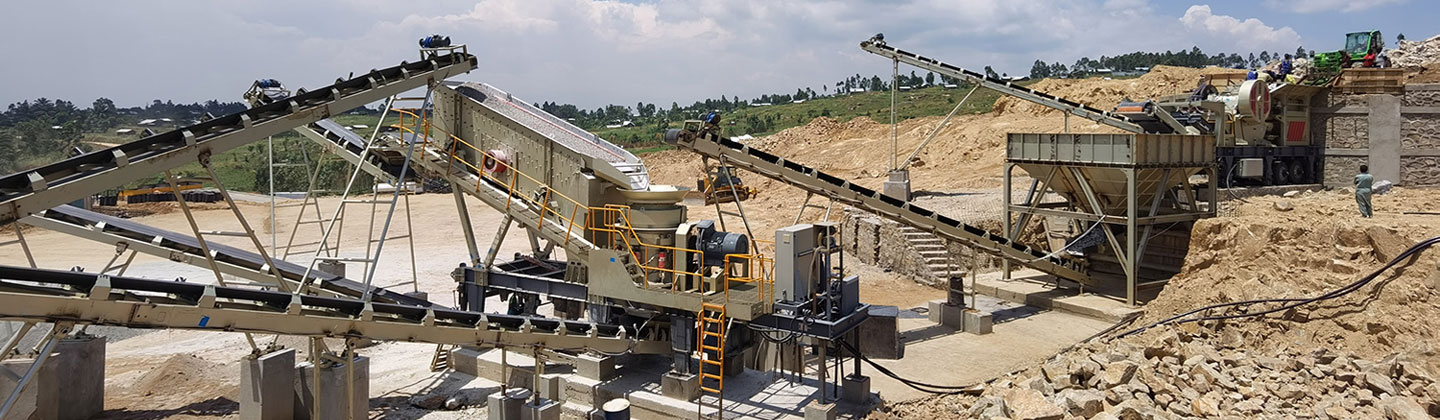
In high-capacity sand and gravel aggregate plants, the configuration of the secondary crushing circuit dictates the structural integrity and geometric compliance of the final output. While primary reduction focuses on gross volumetric breakdown, the secondary stage must transform highly irregular, stressed intermediate feed into premium, cubical concrete aggregate. Integrating a heavy-duty European-type impact crusher as the secondary processing core provides the exact mechanical kinetic energy required to deliver superior grain-size distribution and eliminate structural micro-fissures in the processed stone.
Kinematic Fragmentation Mechanics and Cubical Quality Control
The premium structural performance of a European-type impact crusher stems directly from its high-inertia rotor geometry and multi-chamber impact configuration. Unlike compression crushing, which induces tensile failure along existing rock fissures and can result in elongated, flaky particles, impact fragmentation leverages high-velocity kinetic energy transfer to shatter material along natural crystalline boundaries.
The mechanical process relies on two distinct phases of reduction:
- Primary Impact: Material enters the crushing chamber and is immediately struck by rigid, heavy-duty blow bars anchored to a heavy, cast-steel rotor. The instantaneous transfer of kinetic energy induces severe impact stress, causing immediate fragmentation.
- Rebound & Secondary Striking: The accelerated rock fragments are projected orthogonally toward adjustable, high-alloy impact plates (aprons). Striking these plates triggers secondary fragmentation, rebounding the material back into the path of the rotating blow bars for subsequent reduction.
This repeating loop of impact and rebound ensures a highly uniform aggregate grain-size distribution. By applying multi-directional impact forces, internal stress concentrations within the stone are neutralized, eliminating elongated or flaky geometries. The resulting concrete aggregate exhibits a highly desirable cubic shape with a cubical flaky content strictly controlled below 8%, significantly enhancing the compressive strength and workability of downstream ready-mix concrete formulations.
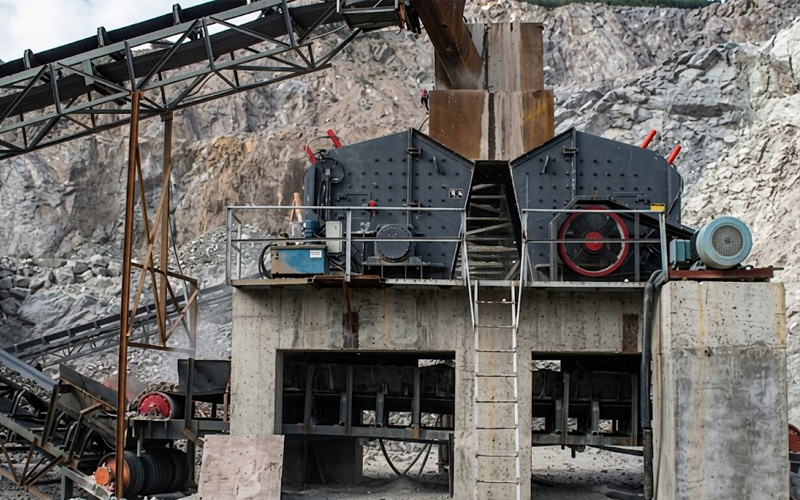
Circuit Synchronization: Primary Feed vs. Secondary Chamber Fullness
To eliminate systemic bottlenecks and prevent accelerated, uneven wear on internal liners, an aggregate production line must maintain a strict mass balance between the primary jaw crusher output and the secondary impact crusher feed. A primary systemic bottleneck occurs when a primary jaw crusher operates with a closed-side setting (CSS) that exceeds the maximum feed boundary of the secondary crusher, or when the feed volume induces transient overloading.
Optimizing the secondary crushing circuit requires careful calibration of the chamber-fullness factor. Impact crushers do not operate efficiently under erratic, non-choked conditions; they rely on an optimal material density within the chamber to ensure particle-on-particle attrition alongside mechanical striking. However, complete overfill causes material cushioning, which reduces the effective tip speed of the blow bars and leads to surging power consumption.
Achieving system equilibrium requires the implementation of an intermediate surge bin equipped with an automated, variable-speed vibrating feeder between the primary and secondary stages. This decouples the primary reduction phase from the secondary impact circuit, guaranteeing a continuous, metered mass flow that maintains secondary chamber fullness at an engineered equilibrium point of 70% to 85% volumetric capacity.
Mechanical Parameter Verification and Equipment Selection
Industrial plant design requires equipment selection based on verified mechanical limits, motor ratings, and throughput boundaries. For heavy-duty secondary processing of medium-hard rock (such as limestone, dolomite, or gravel), the PFW Series of European-type impact crushers provides the necessary structural rigidity and operational flexibility.
The table below outlines the exact technical parameters for heavy-duty three-chamber European impact crushers configured for premium aggregate plants:
| Crusher Model | Configuration / Layer Type | Max. Feed Opening (mm) | Throughput Capacity (t/h) | Electric Motor Power (kW) | Total Machine Weight (T) |
|---|---|---|---|---|---|
| PFW1315V | Three-Chamber Secondary | 500 | 160–260 | 200 | 24.3 |
| PFW1318V | Three-Chamber Secondary | 500 | 210–380 | 250 | 29.2 |
For applications demanding rapid site mobilization or flexible layout reconfigurations, the NK100F Mobile Impact Crusher offers an integrated alternative. Equipped with a heavy-duty impact core, a high-gradient vibrating screen, and onboard return conveyors, the NK100F mirrors the closed-circuit performance of stationary PFW configurations while eliminating the need for poured concrete foundations.
Closed-Loop Gradation Control and Flow Sheet Stability
Achieving stable grain-size distribution across various aggregate specifications requires connecting the secondary impact crusher to a high-capacity vibrating screening system. This closed-loop configuration manages the circuit’s recirculation load to match changing geological feed properties.
Material exiting the PFW impact crusher is discharged directly onto a multi-deck vibrating screen. Any oversize fragments exceeding the target specification (typically greater than 40 mm for concrete aggregate) are isolated and routed back via a return conveyor system to the impact crusher’s intake. This return loop adjusts the chamber fullness toward the target 85% range, stabilizing the rock-on-rock crushing action. By controlling the rotor’s linear tip speed alongside the physical clearance of the impact aprons, plant operators can precisely shift the gradation curve to produce high-value fractions (such as 0-5mm sand, 5-10mm, 10-20mm, and 20-40mm coarse aggregates) while keeping filler dust generation to an absolute minimum.
Frequently Asked Questions
- What is the primary advantage of a European impact crusher over a cone crusher in an aggregate plant?
- European impact crushers rely on dynamic impact fragmentation rather than compression. This mechanical approach yields superior, cubic-shaped final products with significantly lower needle-like and flaky particle content, making it the ideal choice for high-specification concrete and asphalt aggregate standards.
- How does the PFW series handle maximum feed sizes without blockages?
- Models like the PFW1315V and PFW1318V feature an optimized, heavy-duty three-chamber design with a large feed opening that accepts material up to 500mm. The aggressive angle of the heavy rotor configuration ensures that large feed blocks are drawn efficiently into the primary crushing zone without bridging the inlet.
- What causes accelerated wear on impact crusher blow bars, and how is it mitigated?
- Accelerated wear occurs primarily due to non-choked feeding conditions or processing materials with an excessively high silica content. It is mitigated by installing an intermediate surge bin to stabilize feed density, optimizing chamber fullness, and selecting premium high-chromium or martensitic steel alloy blow bars tailored to the specific raw material characteristics.