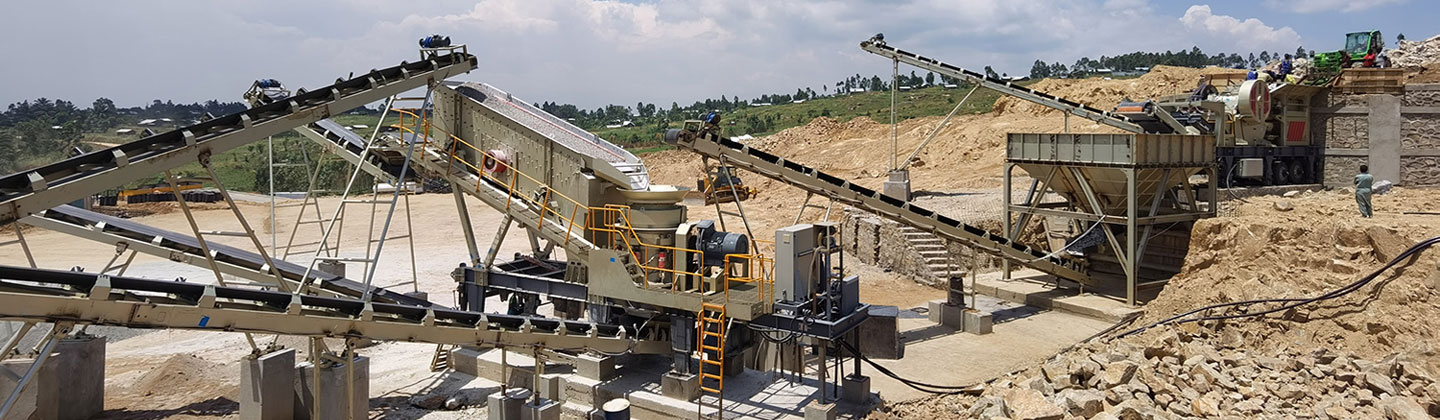
Stone crushing equipment operates under some of the most severe mechanical conditions in industrial processing. Every crushing cycle subjects frames, pitman assemblies, shafts, and supporting components to repeated impact, compression, vibration, and shock loading. For this reason, the structural integrity of heavy-duty steel castings is a critical factor in crusher reliability and asset protection. In advanced machines such as C6X Jaw Crushers and HPT Cone Crushers, integrated cast steel frames and robust cast components provide a foundation for resisting deformation and fatigue. Auditing these components requires a combined assessment of metallurgical quality, structural design, non-destructive testing (NDT), and finite element analysis (FEA).
Auditing Metallurgical Integrity
The reliability of a cast-steel crusher begins with the quality of its material and manufacturing process. Heavy-duty alloy steel castings must possess a controlled chemical composition, suitable mechanical properties, and a consistent internal structure. During an audit, attention should be given to material certificates, heat-treatment records, casting procedures, and traceability from raw material through final machining.
Casting defects such as shrinkage cavities, inclusions, porosity, cold shuts, or cracks can become stress concentrators under repeated crushing loads. Consequently, visual inspection alone is insufficient for critical structural components. NDT methods provide a more comprehensive assessment of metallurgical integrity.
Ultrasonic testing (UT) can identify internal discontinuities and variations in material quality, while magnetic particle testing (MT) is useful for detecting surface and near-surface cracks in suitable ferromagnetic steel components. Dye penetrant testing (PT) can provide additional surface-crack detection where applicable. Radiographic testing (RT) may also be employed to examine internal casting discontinuities. The selected methods should follow applicable standards and documented acceptance criteria, with inspection coverage determined by the criticality of the casting.
Structural Durability of Integrated Cast Frames
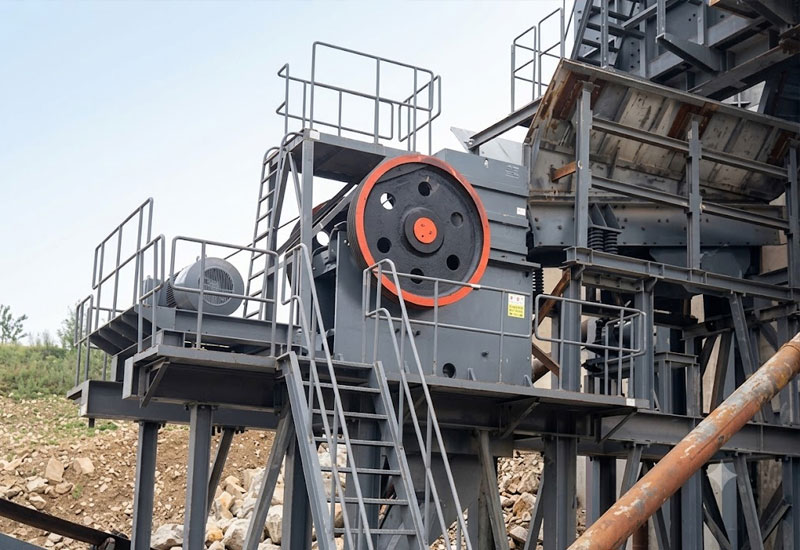
The crusher frame is subjected to substantial forces as rock is compressed and fractured. In a jaw crusher, the pitman assembly transfers cyclic loads through the crushing mechanism and into the frame. In a cone crusher, crushing forces are transmitted through the main structural body and associated load-bearing components.
Integrated cast steel frames can offer structural advantages because they reduce the number of heavily loaded joints and interfaces. A properly engineered casting distributes loads through continuous sections, minimizing localized weaknesses that can arise around bolted or welded connections. High-grade alloy steel also provides the combination of strength and toughness required to withstand high-impact crushing environments.
For C6X Jaw Crushers and HPT Cone Crushers, auditing structural durability should therefore examine critical load paths, casting geometry, connection areas, fillets, bearing seats, and regions surrounding major openings. Evidence of permanent deformation, unusual wear, cracking, or dimensional changes should trigger further engineering evaluation.
FEA Optimization and Stress Distribution
Finite element analysis provides a powerful method for evaluating whether a crusher’s structural design can withstand operating loads. An FEA audit should consider realistic boundary conditions, crushing forces, material properties, contact conditions, and appropriate load cases rather than relying exclusively on simplified static calculations.
Stress concentration is particularly important around transitions in casting geometry, shaft supports, bearing housings, and other areas where loads change direction. FEA can identify these high-stress zones and support optimization of wall thickness, rib geometry, fillet radii, and reinforcement placement.
The objective is not simply to maximize material. Excess material can increase weight and manufacturing cost without proportionally improving reliability. Instead, optimized castings distribute stress more uniformly while maintaining adequate safety margins against yielding, fracture, and fatigue.
Fatigue Resistance Under Repeated Crushing
Crusher structures experience millions of loading cycles during their service life. Even when individual crushing forces remain below the material’s ultimate strength, repeated stress fluctuations can initiate and propagate fatigue cracks.
A comprehensive audit should therefore combine FEA stress results with fatigue assessment and operating-cycle information. Particular attention should be given to areas where cyclic tensile stresses coincide with geometric discontinuities or casting imperfections. High-grade alloy steel, controlled heat treatment, sound casting practice, and appropriate stress-relieving design features can substantially improve resistance to crack initiation and propagation.
Protecting Capital Assets
Metallurgical integrity and structural durability ultimately translate into financial protection. A major frame or pitman failure can cause extended downtime, secondary equipment damage, emergency repairs, and significant production losses. Preventive inspection provides an opportunity to detect defects before they develop into catastrophic structural failures.
For C6X Jaw Crushers and HPT Cone Crushers, an effective integrity program should combine certified material documentation, NDT inspection, dimensional monitoring, FEA-based structural verification, and fatigue assessment. This layered approach provides greater confidence that integrated cast steel frames and pitman assemblies can withstand the severe forces associated with high-impact rock crushing.
Ultimately, heavy-duty steel castings are not merely structural components; they are critical safeguards for the entire crushing system. When metallurgy, casting quality, structural design, NDT, and FEA optimization are addressed together, the risk of frame deformation and fatigue-related failure can be reduced while improving equipment availability and protecting the substantial capital invested in crushing operations.